
Desert-built concrete, priced in writing
Concrete Contractors in Tucson, AZ
Driveways, patios, pool decks and slabs poured around the heat, sloped for the monsoon and quoted line by line.
- Free on-site measuring visit
- Written quote with each part of the job priced on its own line
- Pours scheduled around summer heat and monsoon storms
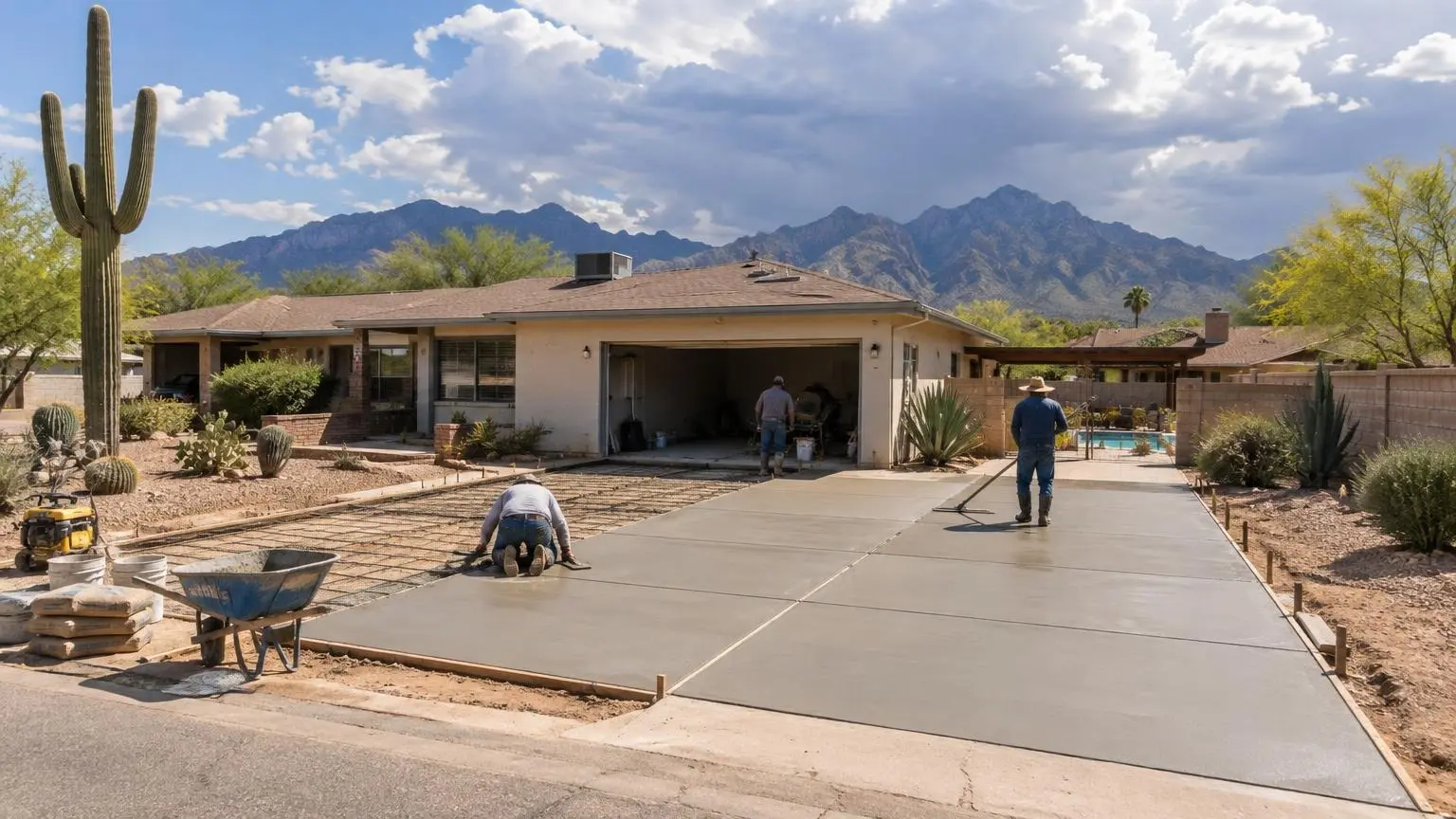
Concrete Built for the Sonoran Desert
Elite Concrete Contractors Tucson builds and repairs driveways, patios, stamped and stained surfaces, pool decks and slabs for homeowners in Tucson, Arizona. Tucson sits at about 2,400 feet in the Sonoran Desert, and the weather shapes almost every decision on a pour. Wikipedia's climate table gives Tucson an average of 158 days a year at 90 degrees or hotter, and the National Weather Service's 1991 to 2020 normals count 68 days at 100 or above. Good concrete contractors in Tucson plan around that heat, and around the summer storms that follow it.
What heat and storms do to concrete
Heat during the pour. Concrete hardens through a chemical reaction with water. On a hot, dry afternoon the mix stiffens faster, the surface loses water to the air, and the crew has less time to finish it. Rushed finishing and fast drying lead to a weak, dusty top layer and early cracking.
Curing in dry air. A slab keeps gaining strength for weeks, but only while it holds moisture. In low desert humidity it needs help: a curing compound, wet curing or both, starting right after finishing.
Monsoon water. The National Weather Service lists normal Tucson rainfall at 10.61 inches a year, and July, August and September together account for about 5.5 inches of that. When a storm drops much of it in an hour, any slab that tilts toward the house, or any edge where water can get under the concrete, becomes a problem.
How we handle it:
- Pours start early in the morning during the hot months, with the base dampened beforehand so dry ground does not pull water out of the mix
- Curing begins as soon as finishing ends
- Every slab gets a planned slope that carries runoff toward the yard or the street
- Control joints are cut on a layout so shrinkage cracks follow straight lines
- If a storm is forecast on pour day, we reschedule
The ground under Tucson
Desert soils across the Southwest often hold caliche, a layer of calcium carbonate that cements sand and gravel together. Wikipedia describes caliche layers that run from a few inches to several feet thick, with more than one layer possible in the same spot. Caliche is hard to dig, and because water cannot soak through it, it can hold rain right under a slab. When we excavate, we dig out loose and soft material, break through caliche where the depth calls for it, and compact a base that gives the concrete even support.
A city of mid-century ranch houses
Point2Homes, summarizing Census survey data, puts the median build year of Tucson housing at 1979. About six in ten homes went up between 1950 and 1989, and the 1970s alone account for 20.2 percent. Wikipedia notes that the city grew from 45,454 people in 1950 to 212,892 in 1960, and that the east side was built mostly from the 1950s through the 1970s.
For concrete, that means a lot of driveways, carport slabs, walks and back patios that are 40 to 70 years old. Common requests on homes that age are widening a single-car drive, replacing a cracked carport slab, adding a patio where there is only dirt or gravel, and fixing sections that have settled away from the house. In the older central neighborhoods, some homes sit in a Historic Preservation Zone, where the City of Tucson says any development needs a permit and a historic design review.
Driveways and the street
The City of Tucson's right-of-way brochure, published by the city's transportation department, lists driveway and sidewalk installs among the work that needs a right-of-way permit, and it quotes City Code Chapter 25: no public sidewalk may be repaired or installed without a written permit from the city. The same brochure says the property owner next to the sidewalk is responsible for maintaining it. A site plan goes with every application, reviews typically take about five working days, and Arizona811 has to be called before any digging. When a driveway job reaches the sidewalk, the apron or the curb, we build the permit into the schedule.
Six kinds of work
- Concrete driveways: replacements, widening, aprons and side pads for trailers or extra cars.
- Concrete patios: new slabs, extensions and paths, sized for a ramada, grill or shade structure.
- Stamped and decorative concrete: patterned, colored and stained surfaces for patios, entries and borders.
- Pool decks: new decks and resurfacing with textured finishes that grip when wet.
- Concrete slabs: pads for sheds, RVs, equipment and detached garages.
- Repair and resurfacing: crack repair, slab lifting, overlays and color for worn concrete.
How a job runs
Measuring visit. We look at the area with you, measure it, note the slope and drainage, and check how close a ready-mix truck can get.
Written quote. Each part of the work is priced separately, and repair options are shown next to replacement when they make sense.
Prep. Old concrete and soft soil come out, the base goes in and gets compacted, and forms are set to grade.
Pour. Steel where the slab needs it, then placing, finishing, joints and curing, timed for the coolest part of the day.
Handoff. You get written dates for foot traffic, cars and sealing. HomeGuide's driveway guide advises at least 7 days before driving on new concrete and about 30 days before heavy vehicles.
When to plan a pour
There is no frozen season in Tucson. Wikipedia's climate table gives a January average low of 40.8 degrees, and snow averages a tenth of an inch a year. That makes fall, winter and spring the easiest seasons for concrete, with mild afternoons and less rush to finish. Summer work is very doable with early starts and careful curing, but the monsoon, which officially starts June 15 and usually brings its first storms in early July, adds weather risk through August and often into September. Call (520) 619-2611 and we will tell you plainly when your project is best poured.
Our Concrete Services
Driveways, patios, decorative work, pool decks, slabs and repairs, each planned around Tucson heat and monsoon runoff.
Concrete Driveways
New, replacement and widened driveways on a compacted base, sloped to shed monsoon runoff and cured properly in the heat.
Learn more →Concrete Patios
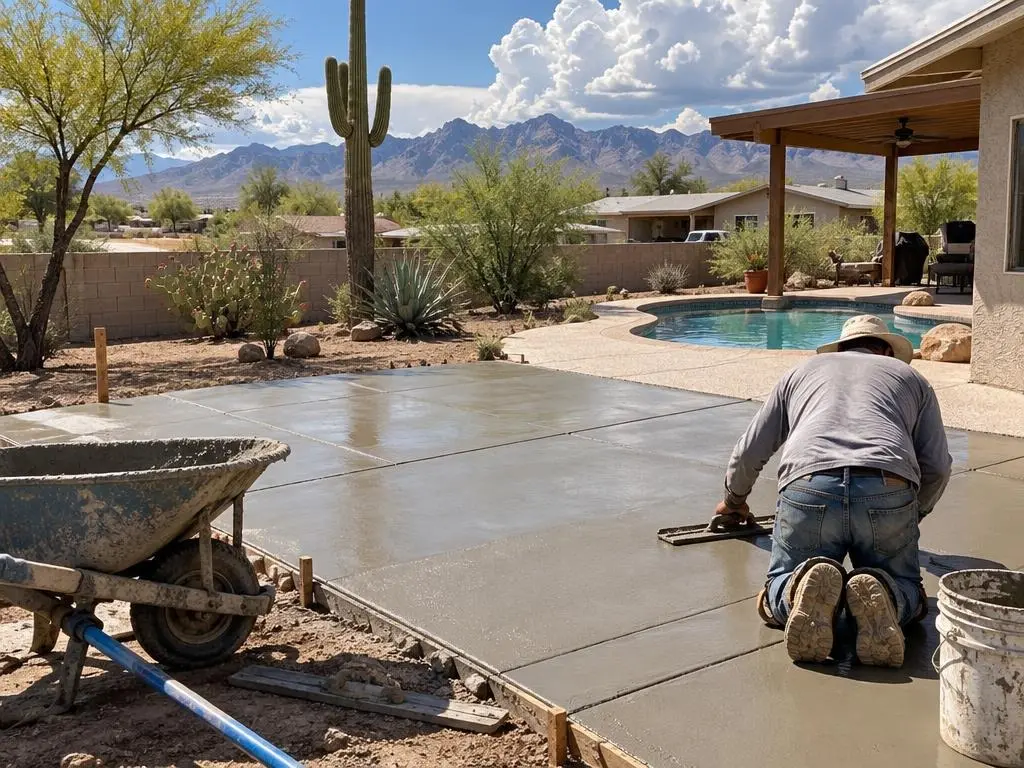
Backyard slabs, extensions and paths, sized for shade structures and outdoor living and sloped to drain in a storm.
Learn more →Stamped & Decorative Concrete
Stamped patterns, color and stain for patios, entries, walks and borders, sealed for desert sun.
Learn more →Pool Decks
New concrete pool decks and resurfacing, with textured, lighter finishes that grip when wet and stay cooler underfoot.
Learn more →Concrete Slabs
Pads for sheds, RVs, equipment, carports and detached garages, sized and reinforced for what will sit on them.
Learn more →Concrete Repair & Resurfacing
Crack repair, slab lifting, overlays and stains that bring worn, cracked or faded concrete back without a full tear-out.
Learn more →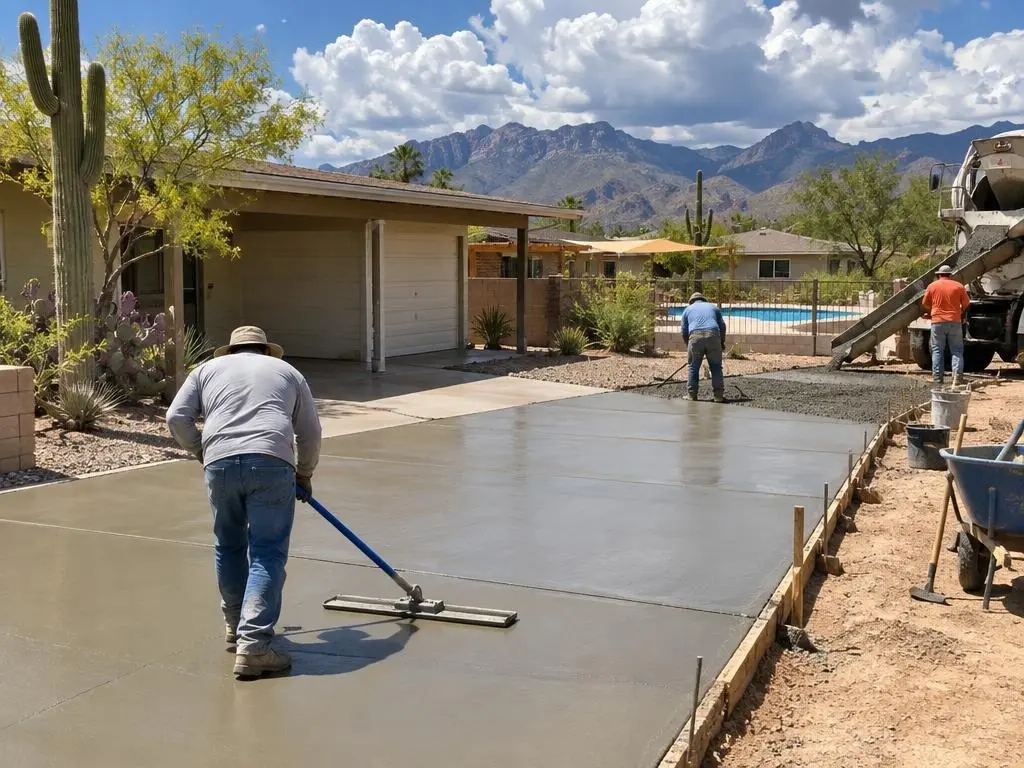
Why Homeowners Call Elite Concrete Contractors Tucson
Poured for the heat
Early-morning pours in hot months, a dampened base and curing that starts right after finishing.
Sloped for the monsoon
Every slab is graded so storm water runs to the yard or street, away from the house.
Line-item quotes
Removal, base, thickness, steel, finish and sealing priced separately, so bids compare fairly.
Permits handled
We confirm what your address needs, including city right-of-way permits for work at the street.
Where We Work
Most of our work is in Tucson itself, from the central neighborhoods near downtown and the university to the east side subdivisions that went up between the 1950s and the 1970s. We also cover the communities around the city: Oro Valley and Marana to the northwest, Casas Adobes and the Catalina Foothills to the north, South Tucson in the middle of the city, Tanque Verde and Vail to the east, and Sahuarita and Green Valley to the south. Each town page covers what we found about local housing, ground and permit rules. Inside Tucson city limits, driveway and sidewalk work at the street needs a right-of-way permit from the city; the towns and unincorporated Pima County set their own rules, so we check them for your address before the job is scheduled.
- Concrete Contractors in Tucson, AZ
- Concrete Contractors in Oro Valley, AZ
- Concrete Contractors in Marana, AZ
- Concrete Contractors in Sahuarita, AZ
- Concrete Contractors in Green Valley, AZ
- Concrete Contractors in Vail, AZ
- Concrete Contractors in Catalina Foothills, AZ
- Concrete Contractors in Casas Adobes, AZ
- Concrete Contractors in Tanque Verde, AZ
- Concrete Contractors in Drexel Heights, AZ
- Concrete Contractors in Flowing Wells, AZ
- Concrete Contractors in Catalina, AZ
- Concrete Contractors in Corona de Tucson, AZ
- Concrete Contractors in Valencia West, AZ
- Concrete Contractors in Avra Valley, AZ
- Concrete Contractors in Summit, AZ
- Concrete Contractors in South Tucson, AZ
- Concrete Contractors in Tucson Estates, AZ
- Concrete Contractors in Rita Ranch, AZ
- Concrete Contractors in Dove Mountain, AZ
- Concrete Contractors in SaddleBrooke, AZ
- Concrete Contractors in Picture Rocks, AZ
- Concrete Contractors in Three Points, AZ
- Concrete Contractors in Rillito, AZ
Common Questions
What should I compare when hiring residential concrete contractors in Tucson?
Get two or three written bids and compare what each one includes, not just the total. Each should state the slab thickness, the base, whether steel is used, the joint layout, the finish, and who gets the permit. Ask how the crew handles summer heat and when they pour. A contractor who can explain why your old slab cracked or sank is more likely to avoid the same problem.
How much does a concrete contractor cost per hour?
Most residential concrete work is not billed by the hour. It is priced per square foot or as a fixed job price after measuring. HomeGuide's concrete price guide lists plain concrete installed at about $5 to $10 a square foot and colored, stamped or stained concrete at about $8 to $18, as national figures. Your written estimate is the actual price.
What is the 10/20/30/40 rule when making concrete?
It is a rough rule of thumb for mixing concrete by hand: about 10 percent cement, 20 percent water, 30 percent sand and 40 percent gravel. A similar 20/30/40 rule puts cement at 20 percent and water at 10. These are shortcuts for small batches. For driveways, patios and slabs we order ready-mix concrete batched to a set strength, which is more consistent than mixing by ratio.
Do I need a permit for a new driveway in Tucson?
If the work reaches the public right-of-way, yes. The City of Tucson's right-of-way brochure lists driveway and sidewalk installs as work that needs a right-of-way permit from the city's transportation department, and city code says no public sidewalk may be repaired or installed without a written permit. We confirm the permit for your address and include it in the schedule.
Can concrete be poured in the Tucson summer?
Yes, with planning. We start early in the morning, dampen the base, keep the crew size matched to the pour so finishing is not rushed, and begin curing right away. If a monsoon storm is in the forecast for pour day, we move the date.
Why did my concrete crack or sink?
The usual causes are a soft or poorly compacted base, water getting under the slab, missing or badly placed control joints, and a slab that dried too fast when it was poured. In the desert, storm runoff that collects along an edge is a frequent culprit. HomeGuide's leveling guide lists soil erosion, poor compaction and moisture as the main reasons slabs sink.
Can old concrete be overlaid or stained instead of replaced?
Often, yes, if the slab underneath is sound. HomeGuide's resurfacing guide says overlays suit minor flaking and cracks under a quarter inch, and that wider cracks, crumbling or spalling usually point to replacement. We look at the slab and price whichever option makes sense.
How long until I can drive on a new driveway?
HomeGuide advises waiting at least 7 days before driving on new concrete and about 30 days before parking heavy vehicles on it. Walking on it is usually fine after a day or two. We give you dates for your slab at the end of the job.
Get a Free Concrete Estimate in Tucson
We measure on site and price the work in writing, anywhere in Tucson and the nearby Pima County communities.